CSDS POLICY BRIEF • 21/2026
By Björn Fägersten
15.10.2026
Key issues
- The failure of the FCAS raises questions about the most effective way to cooperate in defence in Europe;
- A modular approach could preserve national autonomy while simultaneously allowing states and industry to integrate underlying technologies such as engines or a digital cloud;
- A digital backbone could be the biggest strategic opportunity for Europe, allowing different aircraft, sensors and weapons to connect.
Introduction
Several European countries and aerospace firms have ambitions to build sixth-generation fighters. But the aircraft is only part of the proposition: future air power will also depend on how fighters, drones, sensors and weapons work together, drawing on advances in stealth, electronic warfare and Artificial Intelligence (AI)-assisted decision-making. Developing these systems will be costly, especially if Europe pursues several programmes in parallel. This CSDS Policy Brief asks whether a more modular approach can turn some of Europe’s fragmented industrial base into an advantage.
The first downed 6th-gen fighter jet
The French-German ambition to build a joint sixth-generation fighter jet collapsed spectacularly in the summer of 2026, after years of friction. The prestigious project, launched by President Macron and Chancellor Merkel in 2017, always had the odds against it, as Germany and France seemed keen to build rather different aircraft. The inclusion of Spain did not ease matters, nor did the division of tasks among the industries involved. A soft landing was already being discussed in the spring of 2026: the combat cloud element – the digital brain of the system – could continue even if the partners parted ways over the actual fighter jet.
With the fighter component – still the main part of the overall FCAS programme – now shelved, and the partners recalibrating their efforts, the repercussions go far beyond the actors involved. What does it say about European defence cooperation when a sovereignty-defining project between the main continental powers fails to ever take off?
Going forward, European countries planning to fly sixth-generation fighters will have to consider a rather different set of options. For countries planning to buy off the shelf, it remains to be seen which alternatives will actually reach the market. The planned United States (US) systems are so far not intended for export, although a modified version might at some point be available to allies and partners of the US. The British-Japanese-Italian Global Combat Air Programme (GCAP) most likely will be, if it makes it into the air – having an exportable product was one of the main reasons for the United Kingdom (UK) to establish its own project in the first place.
Dassault now seems set to lead a national path towards a new French sixth-generation fighter, while Airbus has proposed a largely German “Team Gen 6” consortium. The German state, however, has indicated that participation in another consortium could again be an alternative, raising the possibility of them joining the British-led project. The future of export controls, the willingness – or need – to keep a human in the cockpit, and the nature of the perceived threat will all shape procurement choices in the years to come.
What could be shared?
For countries with an industrial base that allows for system integration – and hence the ability to develop their own fighter aircraft – or for those with specific areas of expertise that earn them a place in cooperative ventures, new opportunities have now opened up. Indeed, given the fluidity of the defence industry and the kind of product a sixth-generation fighter will be, it is worth asking whether “buy off the shelf / develop in a consortium / build it yourself” is even the right way to think about the alternatives.
A more plausible path may be a modular European sixth-generation ecosystem that combines elements of all three.
The reason such an approach might succeed where an integrated programme failed lies partly in what states are actually being asked to share. FCAS required agreement on the airframe – arguably the part of the system most heavily shaped by national doctrine. That proved extremely difficult. This pattern is visible in how FCAS came apart. The pillars based on delegated cooperation – the engine, combat cloud and sensors – found somewhat workable arrangements. The fighter pillar, which required agreement on a single design, stalled and held up the rest. FCAS struggled most where compromise touched most directly on national sovereignty. A more modular architecture would lower the stakes.
Emil Archambault makes a related argument: a European defence industry is more likely to emerge from a dense network of cooperating sectors than from the transnational super-champions envisaged by FCAS. But what does that mean for combat air? A modular approach offers one answer: several airframes reflecting different national requirements, one or two shared engine families and a common open backbone.
Different parts of the system could be shared to different degrees, allowing states to preserve autonomy where doctrine and sovereignty matter most while pooling capabilities where the political cost is lower. A closer look at some of the key elements of a sixth-generation fighter, and at the European industrial ecosystems surrounding them, illustrates the logic.
The airframe
The airframe – the actual layout and design of the aircraft – is where FCAS seems to have run into its most difficult choices.
An airframe does not merely combine a set of technologies and weapon systems; it embodies the military doctrine of the state procuring it. Large enough for long-range missions, or agile enough for quick interception? Room for two engines or one? What level of stealth is required? Space for one, two or no human pilots? Hence the high cost, and ultimately the difficulty, of compromise between French requirements for carrier operations and a nuclear role and Germany’s lack of such specifications. A recent DGAP study argues that ‘aircraft design cannot be readily broken down into components’. The author takes this as a case for firmer political direction of a joint aircraft; but the same fact supports a different move: letting each state hold its own airframe rather than forcing one design to carry incompatible requirements.
While the sovereignty cost of compromise is substantial in this area, Europe also has several industrial players capable of developing airframes in line with national requirements. Of the current primes with airframe competence, Airbus and Dassault are moving towards national tracks while Leonardo is part of the BAE Systems-led GCAP project. Saab sits outside both FCAS and GCAP, but not outside Europe’s sixth-generation development landscape. Backed by the Swedish state, it is pursuing its own concept and technology programme for future combat air, ahead of Sweden’s decision on its own sixth-generation capability.
Powering the jet
Propulsion is of course central to the fighter aircraft, but it is less closely tied to the doctrine of the state flying it. Among current European fighters, only France has a fully sovereign solution, with Safran powering Dassault’s Rafale, while the Eurofighter relies on a large European consortium and Saab’s Gripen uses an American General Electric engine.
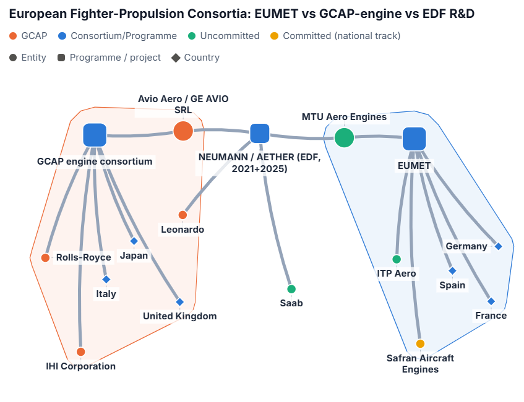
With the collapse of the FCAS fighter project, its planned engine consortium, EUMET, has also seen its contracts expire. MTU and Spain’s ITP Aero are looking for opportunities elsewhere. In contrast to the airframe, propulsion lends itself to a higher degree of modularity. The work on the FCAS engine was already divided between firms. Under EUMET, MTU took the forward section and Safran the aft, echoing the arrangement used for the Eurofighter engine. That arrangement shows that European engine makers already know how to divide development work between them. Engines developed for a new French aircraft or for GCAP could conceivably also be used by other consortia or aircraft developers seeking a European solution.
This sort of modularity is already visible in the underlying research layer driving propulsion innovation. Here, members of different consortia are linked through a dense network of existing working relationships. The European Defence Fund’s core sixth-generation propulsion projects, NEUMANN and its successor AETHER, are coordinated by Avio Aero, itself a member of the GCAP engine consortium.
Nor are the engine producers freed by the collapse of EUMET starting from scratch. MTU already takes part in European research projects alongside firms from across the emerging camps – Leonardo on the GCAP side, Thales and Indra on the combat-cloud side, as well as Saab. A more modular approach to propulsion could build on relationships and research networks that already exist. These research ties make future cooperation more plausible, but using an engine across different aircraft would still require substantial integration work and agreement on who controls its design and interfaces.
Figure 1: The European propulsion ecosystem
Source: Network analysis and visualisation by EDGE defence intelligence platform.
Economies of scale point in the same direction. The European Parliamentary Research Service puts the annual cost of fragmentation and duplication across European defence at €17–€58 billion. A multitude of European sixth-generation tracks would not help those numbers. Even if Europe ends up developing more than two sixth-generation airframes, it is questionable if they all can be powered by separate engine families. Full national sovereignty in propulsion is simply too costly an ambition for most states and industrial actors.
A common combat cloud
Furthermore, the digital backbone of a sixth-generation fighter looks like one of the most promising areas for convergence and cooperation. In FCAS, the air combat cloud has the strongest case for continuation, as argued by a group of experts from the involved countries. Its FCAS-era contracts have largely lapsed since, along with the rest of the programme, but the underlying logic remains. Whatever sixth-generation systems the partners eventually field, they will need a connected “system of systems” to link them. That strengthens the case for rebuilding the combat cloud as a common, open layer. Bellais and Fiott observe that ‘the entity that controls system integration and defines interfaces wields significant influence’. An open combat cloud would therefore need agreement on who sets those interfaces, not just on which aircraft can connect to them.
It will also need to connect seamlessly with other European systems, from the European Sky Shield to space- and land-based connectivity and sensor networks. Full national sovereignty over such a system would come at enormous cost and create difficult interoperability problems. Given the growing expectation that Europeans provide more of their own security, alongside rising ambitions and budgets to strengthen Europe’s technological and defence-industrial base, this looks like a natural area for joint European development – and perhaps for sovereignty exercised at the European rather than national level. It is also an area where current dependencies on the US are a growing concern: the Kiel Institute’s autonomy roadmap suggests that no European combat operation is currently conceivable without ‘the authorization, software or systems of the transatlantic ally’ – a reliance that runs the length of the kill chain, from reconnaissance to fire control. An open digital backbone of this kind is helped by the fact that the layer it would rest on is already relatively diverse. Across Europe’s interoperability and standards work, no single firm dominates; roughly five companies carry comparable weight1. This makes the connective layer of a modular system less dependent on any one supplier, and therefore a natural place to build around open standards and shared interfaces.
The firms already holding the combat-cloud and mission-system work are densely co-invested in one another’s European research: Indra, Thales, Airbus and Saab form a close-knit set of shared EDF projects – Indra and Saab on 26, Indra and Thales on 25, Airbus and Indra on 22 – a standing layer of collaboration an open backbone could draw on rather than assemble anew2.
Conclusion: moving forward
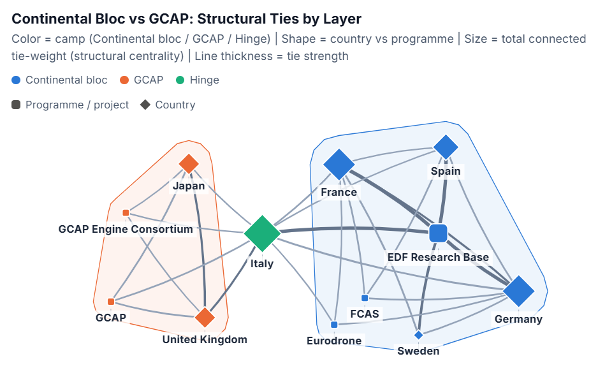
The research network linking the continental producers – France, Germany, Spain, Italy and Sweden – is dense, with each pair of countries sharing dozens of European projects – over 150 between the closest – on top of bilateral ties. GCAP is held together differently. With the UK and Japan outside the European Defence Fund, it relies on a handful of recent treaties and its own industrial governance, without the same shared research base underneath. A modular architecture drawn from the continental base starts from stronger existing links than one that also has to bridge into GCAP.
Figure 2: Continental bloc vs GCAP
Source: Network analysis and visualisation by EDGE defence intelligence platform.
Italy is the important exception. Through Leonardo – which shares 55 EDF projects with Indra alone, the densest tie between any two firms in the set, and ranks as the most heavily networked node in the whole European base – GCAP already has a foot inside the continental system. If Germany moves closer to the British-led project, the bridge is in place, and it runs through Rome.
Looking across the areas discussed above, the sovereignty cost of cooperation is highest for the airframe and lowest for the digital core, where autarky could actually undermine the capability one is trying to create. Bellais and Fiott call for Europeans to ‘increase their own mutual dependence in Europe’. A modular approach would allow that dependence to grow without requiring every country to join the same fighter programme.
Rather than one or two competing consortia, each bundling digital systems, propulsion and airframe into a single programme, Europe could end up with several airframes adapted to national doctrines and different roles within NATO; one or two engine families supplied by a smaller number of European producers; and a common digital backbone designed from the outset to accept different platforms, sensors and other plug-ins. This would not be entirely new. The lethal edge of these systems – their weaponry – has already moved some way down the path of standardisation and modularity, allowing states to mix and switch between systems according to their needs. The failure of FCAS may point the way to a different model for how European sixth-generation cooperation works.
Notes
1: Measured as each firm’s share of weighted lead roles across the interoperability and standards consortia, the least concentrated of the digital-backbone functions (HHI ≈ 2,060). Airbus and Thales hold 23 per cent each, Dassault 21, Leonardo 18 and Indra 14. EDGE defence intelligence analysis, based on public EDF project data 2021–2025.
2: EDGE defence intelligence analysis, based on public European Defence Fund project data, 2021–2025. Shared project counts indicate co-participation, not necessarily joint engineering.
__________
The views expressed in this publication are solely those of the authors and do not necessarily reflect the views of the Centre for Security, Diplomacy and Strategy (CSDS) and/or the Vrije Universiteit Brussel (VUB). No Artificial Intelligence or AI-assisted technologies were used to write this policy brief. AI was used for proofreading in this text. The analysis of firm-level industry and research collaboration draws on the EDGE intelligence platform, a knowledge graph of European defence-industrial relationships in which AI supports access to and analysis of the underlying data; interpretation and conclusions are the author’s. Image credit: AI-generated using ChatGPT.
ISSN (online): 2983-466X